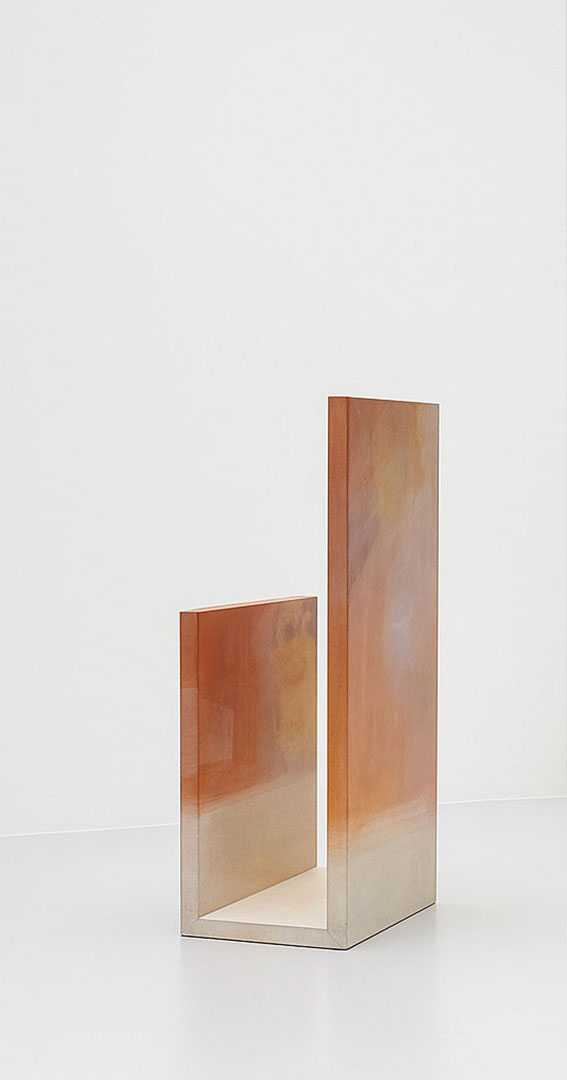
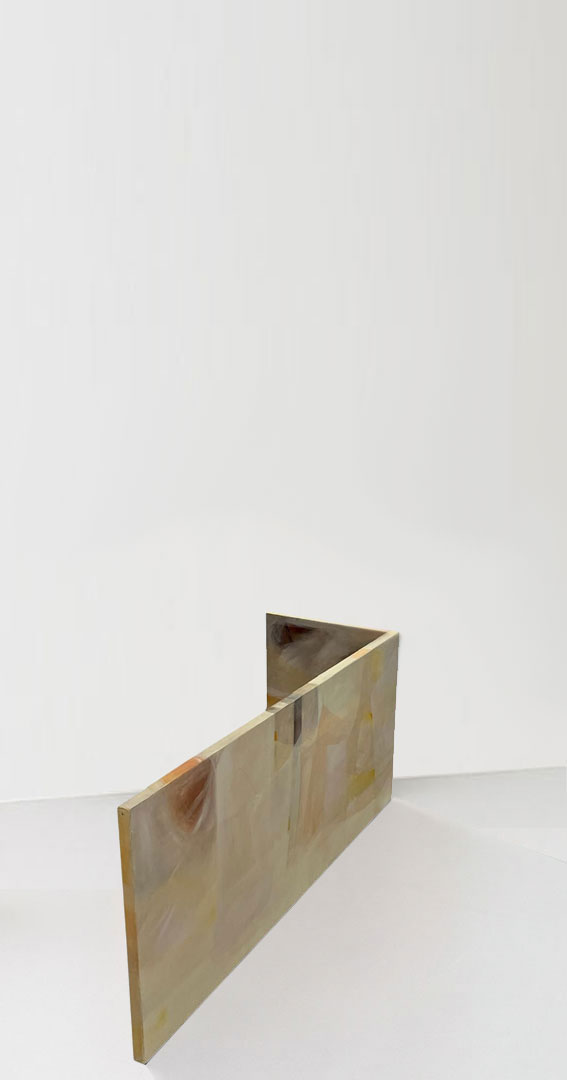
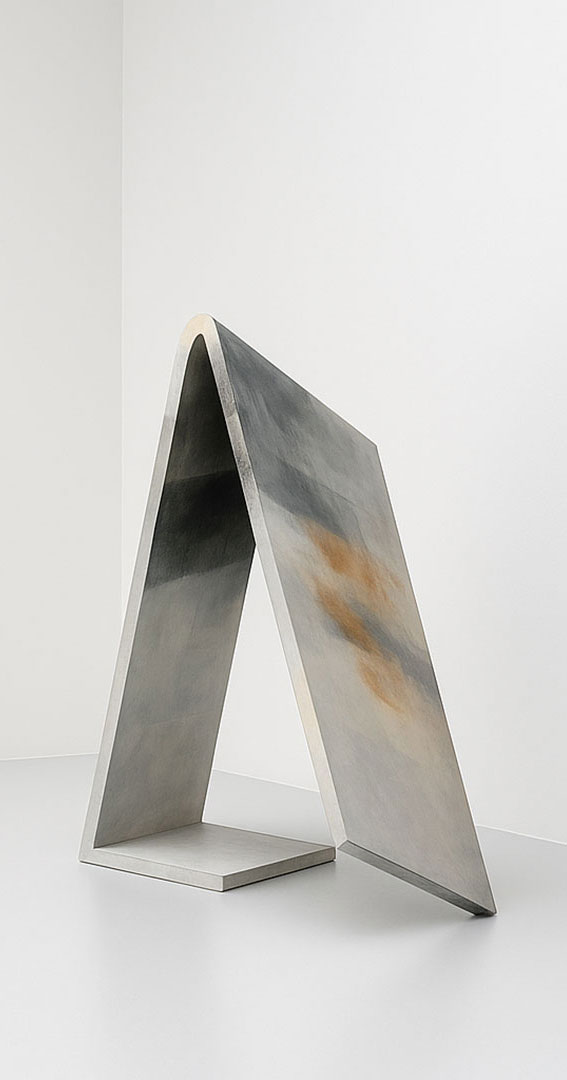
Sculptural Paintings
The Sense of Time
Installation, 2025
7 × 4 m

Sculptural Paintings
This instalation explores the complex nature of time through both theoretical investigation and artistic practice. Anchored in Einstein’s general theory of relativity, it departs from the Newtonian notion of absolute time and embraces time as relative, personal, and path-dependent – where space and time together curve into a four-dimensional spacetime. The sculptural paintings created for this work reflect this curvature: large, three-dimensional forms that bend and curve, embodying both spatial and temporal dimensions. Time on these works flows “faster” at the top than at the bottom, expressed through changes in brushstroke rhythm and color: faster, busier, and more colorful at the top; slower, peaceful, and monochrome at the bottom.
Beyond physics, the work acknowledges the deeply subjective experience of time. Neuroscience suggests our perception of time is shaped by emotion, memory, anticipation and the brain’s innate time-telling. The installation interweaves personal reflections on time’s elusive presence in life and art, forming a narrative that is both – scientific and intimate. Ultimately, the work argues for a view of the world not as a collection of static things, but as a constellation of events – where becoming, not being, is at the heart of existence.
“(..) and – the only way how to think about the world, the only way that is compatible with relativity is that the world is not a collection of things, it is a collection of events. The difference between things and events is that things persist in time; events have limited duration. A stone is a prototypical “thing”: we can ask ourselves where it will be tomorrow. Conversely, a kiss is an “event”. It makes no sense to ask where the kiss will be tomorrow. The world is made up of network of kisses, not stones.”
Carlo Rovelli, The Order of Time
Literature that shaped the work
Buonomano, Dean. Your Brain Is a Time Machine: The Neuroscience and Physics of Time.
Carroll, Sean. The Biggest Ideas in the Universe: Space, Time, and Motion.
Rovelli, Carlo. Reality Is Not What It Seems: The Journey to Quantum Gravity.
Rovelli, Carlo. There Are Places in the World Where Rules Are Less Important than Kindness.
Rovelli, Carlo. The Order of Time.
Hassani, Sadri. From Atoms to Galaxies: A Conceptual Physics Approach to Scientific Awareness.
Topper, David. How Einstein Created Relativity out of Physics and Astronomy.
Hossenfelder, Sabine. Lost in Math: How Beauty Leads Physics Astray.
On Time
Time is like painting to me: it records everything meticulously – every sequence of every visual contemplation. It captures my intentions, hesitations, and determined brush-moves. It preserves the format, size and proportion I use, the areas I create, and the way they communicate – or fail to do so. It records color with its structure and texture, the sweeping lines I apply, the rhythm in my gestures – or the lack of it. It reflects every tension, weight, and depth I achieve or fail to achieve, as well as my focus and center. It registers the symmetry I often accomplish unwillingly, the composition, and the level of abstraction in it. It traces what happened first in the very background, what followed in subsequent layers, and what rests on the surface now. It also indicates what may happen next.
Time records an entire flow. However, I am not aware of it, nor do I contemplate it. Time does so for everything else I do. It seems to write a diary about me without permission and at all times. It has gained importance similar to that of breathing.
The Sense of Time
Installation, 2025
7 × 4 m
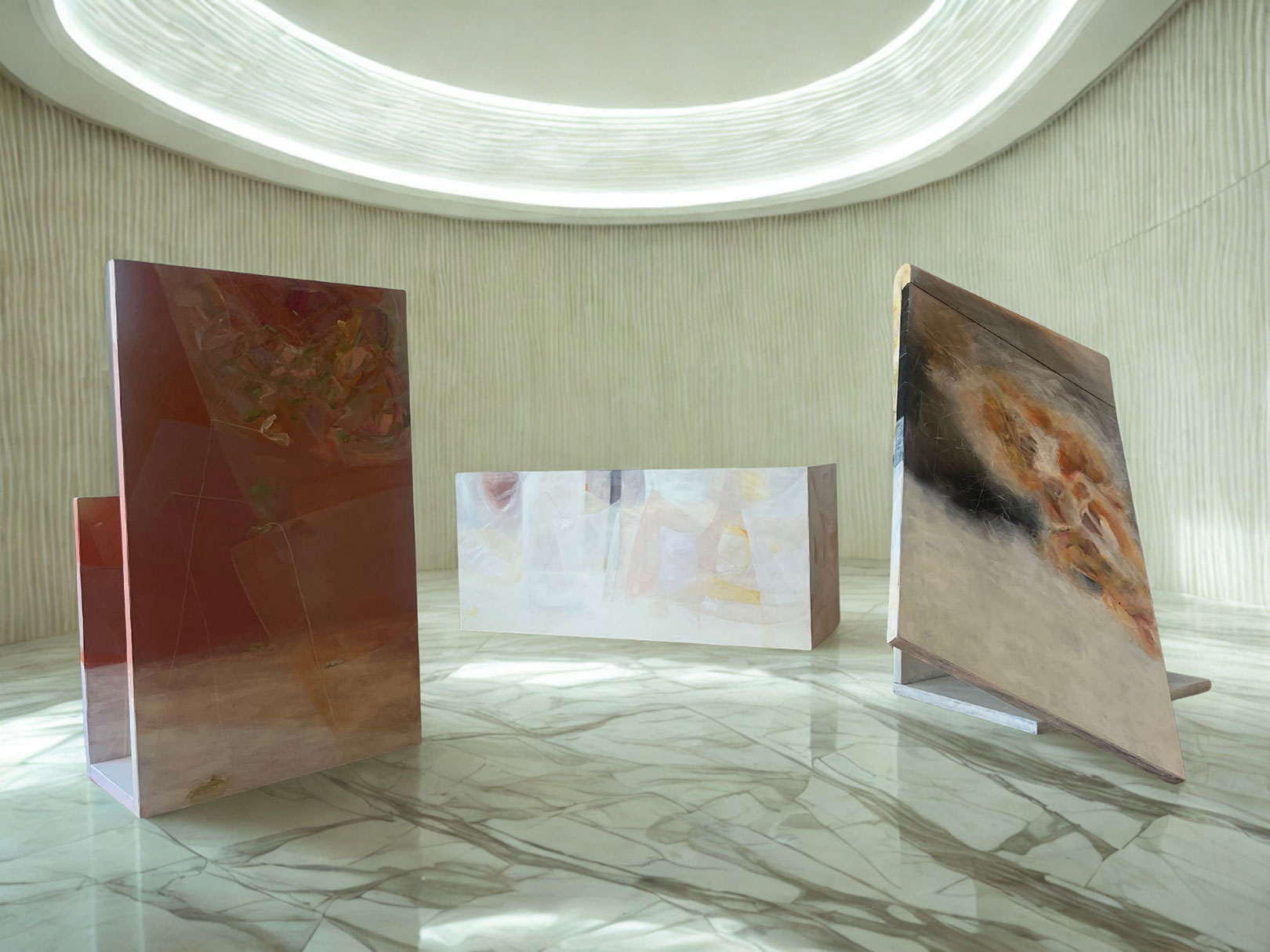
The Sense of Time
Installation, 2025
7 × 4 m
Time of Childhood
Acrylic on Canvas,150 × 177 × 110 cm
Time of Youth
Acrylic on Canvas,140 × 80 × 48 cm
Time of Maturity
Acrylic on Canvas, 80 × 240 × 60 cm